



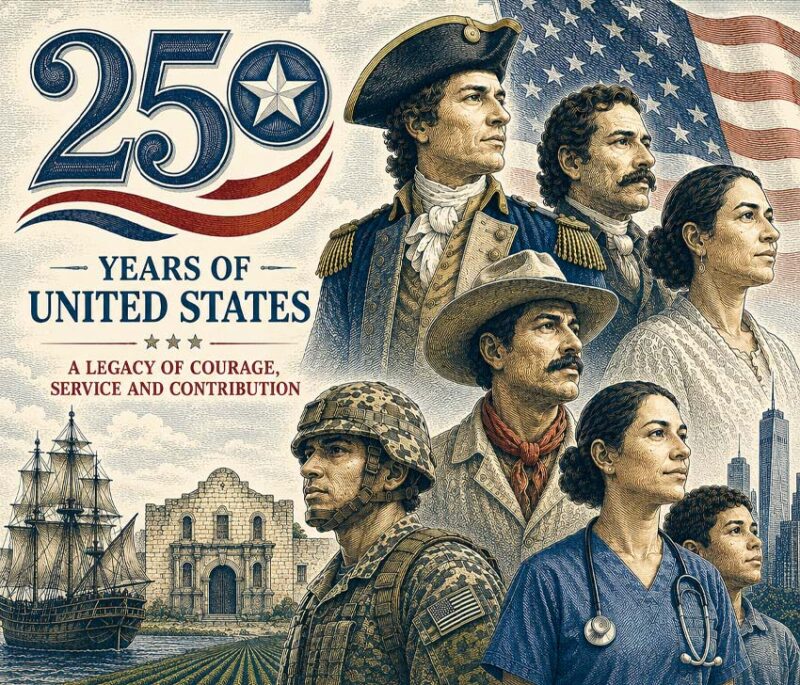
As the United States celebrates the 250th anniversary of its independence, history invites us to look beyond the familiar names found in most textbooks. The story of this nation was also shaped by the vision, sacrifice, and determination of thousands of Hispanics whose contributions have often remained overlooked despite their lasting impact.
The Latino presence in what is now the United States began long before July 4, 1776. In 1565, Spanish explorer Pedro Menéndez de Avilés founded St. Augustine, Florida, the oldest continuously inhabited European-established city in the United States. Decades before the nation was born, Spanish explorers, soldiers, missionaries, and settlers were already exploring, mapping, and developing vast regions that today are part of the country.
One of the most influential—yet least recognized—figures in the American Revolution was Spanish military leader Bernardo de Gálvez, governor of Spanish Louisiana. While George Washington fought British forces along the East Coast, Gálvez launched a successful military campaign against the British along the Gulf Coast, capturing Baton Rouge, Mobile, and Pensacola.
Beyond his battlefield victories, Gálvez supplied the Continental Army with weapons, gunpowder, medicine, food, and other critical resources. He also opened the Mississippi River as a vital supply route. Many historians agree that Spain’s military and financial support, led by Gálvez, played a significant role in weakening British forces and helping secure America’s victory in the Revolutionary War.
Another key figure was Diego de Gardoqui, a Spanish merchant and diplomat from the Basque region. His family provided financial assistance, military supplies, and commercial support to the emerging United States government during a time when resources were desperately needed. Their contributions helped sustain several military campaigns during the struggle for independence.
Decades later, during the fight for Texas independence, Hispanic leaders once again played essential roles that are often overlooked. Among them was José Antonio Navarro, a descendant of a prominent Navarrese family that settled in San Antonio. Navarro became one of only two Hispanic signers of the Texas Declaration of Independence in 1836. He contributed not only his political leadership but also his personal resources to support the independence movement and later became a strong advocate for the rights of Mexican Texans after annexation.
Another important figure was Juan Nepomuceno Seguín, a Tejano military leader and politician of Spanish and Mexican heritage. He fought alongside Sam Houston during the Texas Revolution and played a vital role in the decisive Battle of San Jacinto, which secured Texas’ independence. Despite his courage and service, Seguín later faced discrimination, and for many years his contributions received little national recognition.
These historic pioneers were followed by generations of Hispanic Americans who served honorably in the U.S. Armed Forces. Among them was David G. Farragut, the son of a Spanish immigrant who became the first four-star admiral in the history of the United States Navy. His leadership during the Civil War helped preserve the Union and established him as one of the nation’s greatest naval commanders.
The Latino community has also been instrumental in building America’s economy. For more than two centuries, Hispanic farmers, construction workers, factory employees, entrepreneurs, teachers, physicians, engineers, and small business owners have helped shape the nation’s infrastructure, industries, and local communities through hard work and perseverance.
During the 20th and 21st centuries, that legacy continued through leaders such as Roberto Goizueta, who transformed The Coca-Cola Company into one of the world’s most successful corporations; Dr. Antonia Novello, the first woman and first Hispanic to serve as U.S. Surgeon General; Justice Sonia Sotomayor, the first Latina to serve on the U.S. Supreme Court; Ellen Ochoa, NASA’s first Hispanic female astronaut; Gloria Estefan, whose music introduced Latin culture to audiences around the world; and José Andrés, the Spanish-born chef internationally recognized for his humanitarian work following natural disasters.
Yet the true Latino legacy belongs not only to well-known figures. It lives through millions of families who, generation after generation, have worked in farms, factories, hospitals, schools, laboratories, businesses, and neighborhoods across America. Their dedication, resilience, and entrepreneurial spirit have helped build a stronger, more diverse, and more prosperous nation.
As the United States commemorates its 250th anniversary, it is only fitting to recognize that the country’s history cannot be fully told without acknowledging the contributions of the Latino community. From the explorers of the 16th century to today’s scientists, entrepreneurs, artists, educators, service members, and community leaders, Latinos have helped shape America’s past and continue to play a vital role in its future. Their story is one of courage, innovation, sacrifice, and hope—a legacy that will continue to inspire generations for centuries to come.
